Br. Simon make simple vows
Uncategorized

First Profession of Brother Simon

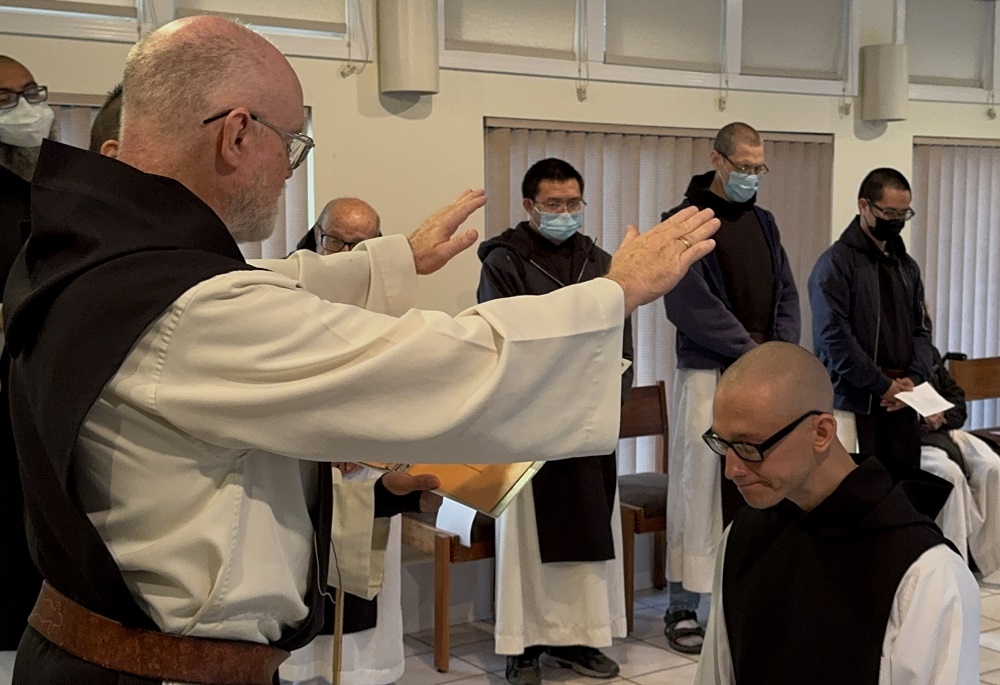
We are pleased to announce that on Sunday, November 23, our Brother Simon Voung professed his first vows before the monastic community of Our Lady of New Clairvaux Abbey gathered in the Chapter Room. Abbot Paul Mark Schwan presided at the ceremony. Brother Simon vowed to observe stability, obedience, and conversion via the monastic way of life according to the Rule of St. Benedict. He was then clothed in the black scapular and leather belt of a professed monk.

Brother Simon is clothed in the black scapular and leather belt of a professed monk at New Clairvaux Abbey


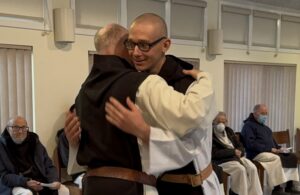
Brother Simon gets a congratulatory hug from Abbot Paul-Mark after professing his vows.


PROFESSION TALK BY ABBOT PAUL-MARK SCHWAN

Profession of First Vows of Brother Simon Peter Vuong, Nov 24, 2024

Brother Simon, there are a number of prescribed prostrations found in our Rule.  Some of these make satisfaction for a monk’s conduct when it is contrary to monastic life.  Other prostrations are prescribed to calm the anger of a brother and bring about reconciliation.  Still other prostrations are expressions of submission and honor to God, e.g. at the exposition of the Blessed Sacrament, at the death of Jesus at the solemn proclamation of the Passion, or in reverence for the Trinity at the Gloria.  Another prostration occurs at the time of solemn profession when the monk falls at the feet of each senior to beg his prayers and his mercy.

Today you have also prostrated before this community to beg for God’s mercy through these brothers!  This is a great act of faith on your part that God’s mercy should be so revealed and received through these your brothers.  It is also a great risk on the part of God that his mercy can manifest itself through these your brothers.  This prostration, as do all our prostrations, symbolizes the essential need for you, Brother Simon, to practice humility, because God has first practiced great humility on taking on the human condition with all its brokenness, its sin.  A full-length prostration places your entire body on the ground, reminding you that you, in your earthly elements are indeed part of the earth, the soil, upon which you stand.  And it is in mercy, an aspect of God’s love, that God lifts you up and fills you with his own divinity, again through these brothers of yours, and in this way you become a new creation, called, chosen, and named by the Incarnate Word of God to be with him, as the theme of our retreat reminded us.

Today then, as you make your first vows, you are being welcomed into this community.  From this day forward you are no longer a foreigner, a stranger, for you belong to God’s people as found in this community, with us, your brothers.  This makes you a member of the household of God, here at Vina, with us, your brothers with all the privileges and rights, that belong to a member of this community, of this Order, of this Church.  And if you have rights, you also have obligations to witness to the gospel with all your heart through the common will as our community expresses it.

And so, I ask you Brother Simon, do you freely seek Christ by committing yourself to him in a life according to the Rule of Saint Benedict, vowing Obedience, Stability in the community and Fidelity to Monastic Life?

May the Lord bring to perfection in you the work He has begun.    I invite you now to pronounce your vows and I will receive you as a professed monk of our Order.


Please pray for Brother Simon and all those responding to God’s call at New Clairvaux.

Blessings,

your brothers of New Clairvaux

A Trappist monk rides a bike under green trees.
Uncategorized

On Inner Silence

We start a new series in which the monks of New Clairvaux answer questions sent to us by our viewers. Brother Christopher gets us rolling, replying to the question, “Do you have any suggestions concerning maintaining inner silence if one lives in the world?”

Great question! The first thing to consider is: what is inner silence? It is not the absence of thoughts; thoughts are an innate part of our human nature and they will be with us as long as we live, as much as a beating heart or blinking of eyes. I would define inner silence as an inner tranquility and calm in the midst of whatever may be happening in our lives, good or ill. The foundation of this calm is the firm sense of God present with us and to us at the core of our being, a fact that nothing exterior can ever change. How does one maintain this form of inner silence? The only way I know is faith; that is, to cultivate our sense of God’s presence through continued returning to God in prayer and constant conversation with Him throughout the day. Scripture says, pray without ceasing. I hope that helps answer the question.

God bless you,

Your brothers of New Clairvaux

#innersilence #faith #calm #thoughts #God #monks #trappist #newclairvaux

Trappist monk holds a bowl of incense
Uncategorized

The Vow of ‘Conversatio’

Br. Peter Gao shares on the monastic vow of Conversatio: “One of the key aspects of our Cistercian life is the profession of ‘Conversatio’, a Latin term that encompasses the idea of conversion and a continuous turning toward God.

Conversatio is more than just a vow; it is a lifelong commitment to spiritual growth and transformation. This concept is deeply rooted in the Benedictine tradition, where monks commit to a life of stability, obedience, and conversion of ways. This conversion involves a daily dedication to living out the monastic values of humility, simplicity, and community. It is an ongoing process of personal transformation, striving to align one’s life more closely with the teachings of Christ.

Also, the journey of Conversatio is not a solitary one. It is deeply communal, as we support one another in our shared commitment to this path. Living in community provides us with the strength and encouragement needed to persevere in our spiritual journey. We learn from each other’s experiences and grow together in faith. The communal aspect of Conversatio reminds us that we are not alone in our struggles and that together, we can achieve greater spiritual growth.

Moreover, Conversatio calls us to a life of simplicity. By embracing simplicity, we free ourselves from the distractions of material possessions and focus more on our spiritual growth. This simplicity is reflected in our daily lives, from the way we dress to the way we interact with the world around us. It is a constant reminder to prioritize our relationship with God above all else.

May God grant us the humility and patience to acknowledge and accept our imperfections and weaknesses and may He help us to grow in holiness and love each day.”

Peace and Joy,

Your brothers of New Clairvaux

#Conversatio #monasticvows #Benedictine #tradition #transformation #simplicity #spiritualgrowth #Cistercian #humility #community #conversion #latin #stability #obedience #dedication #NewClairvaux #monks


A trappist monk in habit and apron works in the monastery bakery, holding a loaf of fresh bread.
Uncategorized

‘Normal Mysticism’: Blessed be God!

Fr. Thomas speaks on the phrase “Blessed Be God”: Many years ago, I read something to the effect that the way we pray gives clear indications on how we understand God!
Recently, I came across in a book a chapter by Peter Ochs, a prominent professor of Jewish theology. He was speaking about traditional Jewish prayer consisting of petitions, praise, & blessing, and wrote about the Blessing ‘Berachah’, which is the response “Blessed be God.” This response implies neither to bless God nor to be blessed by God. Rather, it is a profession or declaration that every event in daily life is a direct consequence of God acting in the world. ‘Normal mysticism’ is the phrase Ochs uses. What happens in our daily life is transformed into an experience and acknowledgement as a “gift from God.” In other word, by praying “Blessed by God” we profess that anything and everything can be transformed into a ‘created word of God.’
The Roman Catholic Missal prescribes “Blessed be God” as the response when the Mass celebrant offers the bread and wine for Consecration. With this response, we profess our Belief that this bread and wine will soon become the Body and Blood of Jesus Christ, and indirectly, our Belief in the great mystery of the Incarnation.
This form of personal prayer can incorporate us into the life of Christ and culminates in a contemplative grace freely giving an understanding of Christ that comes directly from the Father, an experience defying words as it is the work of the Holy Spirit.

May God’s blessing pour out on us all,

Your brothers of New Clairvaux

#Berachah #Blessing #JewishTheology #NormalMysticism #BlessedBeGod #RomanMissal #PeterOchs #prayer #transformation

Bell tower as seen through corridor archway
Uncategorized

Interior Life and Health

Fr. Placid shares on afflictions to our interior life: “We can be interiorly afflicted in two ways: lack of discernment and lack of interior recollection in prayer. Lack of discernment is a kind of darkness of ignorance. It is a form of not knowing right from wrong. It sounds straightforward. We can say it is truly a lack of discernment. What does it mean to praise what is blameworthy? Such confusion is a lack of sobriety in thinking and behavior. We have all experienced correcting someone who does not understand they have done anything wrong. There is also a subtlety about clarity of mind when dealing with situations that are not clear. We might say choosing what is better over another good. The more we grow in self-knowledge and discernment of the best action of the moment, the more adept we can be to step out of this type of darkness.

The second type of ignorance is lack of interior recollection or prayerfulness. Saint Paul describes this ignorance in Romans 8:26 as not “praying as we ought.” It is praying as if trying to find the way out of a cave. We can experience our time of Lectio Divina as fumbling through a passage and not knowing where God is taking us. The remedy for both afflictions is striving to experience God’s illumination exteriorly and interiorly.”

Blessings,

Your brothers of New Clairvaux

#prayer #interiorlife #affliction #ignorance #discernment #recollection #illumination #NewClairvaux #monks


A lemon tree
Uncategorized

The Lemon Tree

Fr. Paul Mark reflects on the Broken Lemon Tree: We have one lemon tree in our citrus grove. It is not fair to say the lemon tree is neglected but it does seem a bit forlorn, not cared for as much as the orange and grapefruit trees. Often its limbs break due to a heavy crop of lemons or caused by a strong wind. I remember 40 years ago half the tree collapsed under the weight of the lemons it bore. The poor tree was a mess, but it healed the scar and kept growing.
Today I walked past and noticed another broken limb and I sighed. Poor tree, I thought to myself, another broken limb. Who needs another broken limb? Having broken my left shoulder over a year ago due to a fall I can commiserate with our lemon tree. I know how it feels.
What is amazing is that this lemon tree is over 50 years old. It was thriving in 1980 when I entered the monastery, and it continues to thrive. Every year it produces a generous crop of lemons, far too many for us monks to consume even when we make gallons of lemonade, which are readily drunk by thirsty monks.
What the lemon tree teaches me is perseverance and resilience. Despite broken limbs, the near complete destruction of the tree, or the frost that set it back when an Alberta clipper made it way through California in 1990, our lemon tree continues to grow, to thrive, to keep giving, to produce abundantly.
Oh, that I may be like that lemon tree, come what may. Give me strength Lord to trust in your all-powerful strength, care and love for me. May I hold to the hope that you Lord provide the growth, the healing, the life, and the fruit in my life.

Blessings,

Your brother of New Clairvaux

#lemontree #resilience #trappist #monks #newclairvaux

Dom Paul Mark extends hands in prayer over Brother Isaac at his first profession of vows
Uncategorized

First Profession of Brother Isaac

The monastic community of Our Lady of New Clairvaux Abbey gathered in the Chapter Room on Sunday, October 13, as Brother Isaac Okolovich professed his first vows. Abbot Paul Mark Schwan presided at the ceremony. Brother Isaac vowed to observe stability, obedience, and conversion via the monastic way of life according to the Rule of St. Benedict. He was then clothed in the black scapular and leather belt of a professed monk.

Dom Paul Mark hugs Brother Isaac in congratulation at his first vows

Please pray for Brother Isaac and all those responding to God’s call.

For those interested in exploring joining our way of life, we invite you to visit our page Becoming a Monk

African style wood crucifix
Uncategorized

Jesus and the Repentant Thief

On Oct. 12 the Church celebrates the memorial of the Repentant Thief. Fr. Thomas shares what this scriptural saint means to him: The narrative about the repentant thief in Chapter 23 of St. Luke’s Gospel has fascinated me, a fascination that was deepened when I was able to spend some time with the community of our Trappist Abbey of Latroun, in Israel. A tradition since the 1300s claims the Latroun area (halfway between Jerusalem and Tel Aviv) as the birth-area of the repentant thief. More likely the name ‘Latroun’ is not a derivative from the Latin, ‘latro’, meaning robber, but from the name of the fortress, La Toron de los Caballeros, of the Knights Templar, the ruins of which are on the monastic property, a fortress established by medieval crusaders.
The Scriptural narrative of this repentant robber has significant implications for our relationship with Jesus. In rebuking the other criminal, also crucified with them, the repentant thief acknowledges the divinity of Jesus, implicitly saying that Jesus is both human and divine. The repentant thief addresses Jesus by his personal name. The repentant thief asks Jesus to remember him when Jesus enters his kingdom. This acknowledges both the kingdom as eternal happiness and Jesus as king. Jesus’ kingship is basic in the annunciation to Mary. It surfaced from time to time in Jesus’ public life and is at the heart of his Passion. Jesus was crowned with thorns, sacrilegiously mocked as ‘king’ and spit upon by vulgar Roman soldiers. Its title was nailed to the top of the cross. The repentant thief does not request forgiveness but requests to be with Jesus, a request containing both a need for salvation and to be forever with the Word Incarnate. I believe that this relationship between Jesus and the repentant one, both sharing a death by crucifixion, reveals elements of a profound intimacy between them. What a magnificent way to share the last moments of their human lives!
Blessings,
Your brothers of New Clairvaux

#RepentantThief #latroun #redemption #crucifixion #King #GospelofLuke #NewClairvaux

Black Madonna of statue of the Blessed Virgin Mary and Christ-Child from New Clairvaux Abbey
Uncategorized

The Virgin Mother’s Gift

Br. Christopher on the Special Gift of the Virgin Mother: “Some people, both within and without the Catholic Church, are uncomfortable about how much attention is given to the Blessed Virgin Mary by those devoted to her. The concern comes from a well-meaning intention: they feel that Jesus should be at the center of a Christian’s life. And no one would agree more with that feeling than Mary! So let’s talk about Mary and her role.

Jesus alone is Divine, God and Man. Only Jesus can Save. Our Lady is like us in that she is fully human, but also unlike any other Christian because of the totally unique role she plays in salvation history: to give a human nature to God so that He could redeem us.

Mary’s being, her life, her virtues, actions, and privileges, were all given by God to help reveal her Son to us. Mary is all about Jesus, about bringing us to know Jesus. One cannot fully know or understand Jesus and His Mission without knowing His Mother. As St. Louis of Montfort put it, the reason Jesus is not better known is because Mary is not better known. Mary is not optional.

To use a strange analogy: Mary is a math tutor, Jesus is Math. It is not about the tutor but about the subject. Those who think we pay too much attention to the tutor should realize that we are only doing so because we want to learn the Subject the best we possibly can. And in Mary we have the best guide, someone who knows her subject better than anyone else who will ever live. She is not a rival to Jesus but the best aid we will ever have in living out a fully Christ-centered life.”

God bless you,

Your brothers of New Clairvaux

#BlessedVirginMary #Jesus #Christian #Christianity #Christ #catholic #tutor #trappist #monks #newclairvaux

Portrait of Trappist Monk Thomas Merton
Uncategorized

Like a Diamond

We share a favorite quote from 20th Century Trappist monk and spiritual writer Fr. Louis of Gethsemane, better known by his pen name Thomas Merton. “At the center of our being is a point of nothingness which is untouched by sin and by illusion, a point of pure truth, a point or spark which belongs entirely to God, which is never at our disposal, from which God disposes of our lives, which is inaccessible to the fantasies of our own mind or the brutalities of our own will. This little point of nothingness and of absolute poverty is the pure glory of God in us. It is so to speak His name written in us, as our poverty, as our indigence, as our dependence, as our sonship. It is like a pure diamond, blazing with the invisible light of heaven. It is in everybody, and if we could see it we would see these billions of points of light coming together in the face and blaze of a sun that would make all the darkness and cruelty of life vanish completely … I have no program for this seeing. It is only given. But the gate of heaven is every- where.”
― Thomas Merton, Conjectures of a Guilty Bystander

Eternal Peace and Blessings,

Your brothers of New Clairvaux

#merton #trappist #monks #newclairvaux

1 2 3 4 5 … 11 12